
INTRODUCTION
The reality of the here and now, is that digital transformation is no longer a nice-to-have. It has become an important part of building organisations that are sustainable, resilient and capable of delivering greater impact.
The good news is that digital transformation isn't really about technology. It is about creating more effective ways of working that are relevant to the here and now and which can be future-proofed to respond to advances in technology.
CONTEXT
Why Digital Transformation Matters Now
The environment in which charities and nonprofits operate has changed significantly.
The National Council for Voluntary Organisations (NCVO) describes the sector as facing a "perfect storm" of rising demand, increasing costs and financial pressures." Against this backdrop, organisations need to find ways to:
- work more efficiently;
- reduce administrative burden;
- make better use of limited resources;
- evidence their impact more effectively; and
- make better decisions more quickly.
This is where digital transformation becomes important.
The Sector Knows Digital Matters
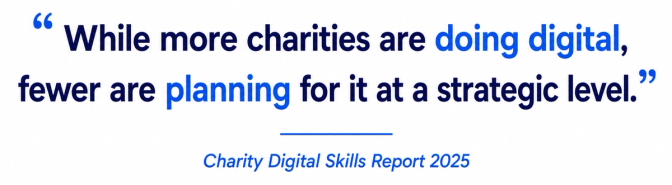
Digital transformation is now a priority for most charities, but many still lack the strategy, capacity and investment needed to turn ambition into action.
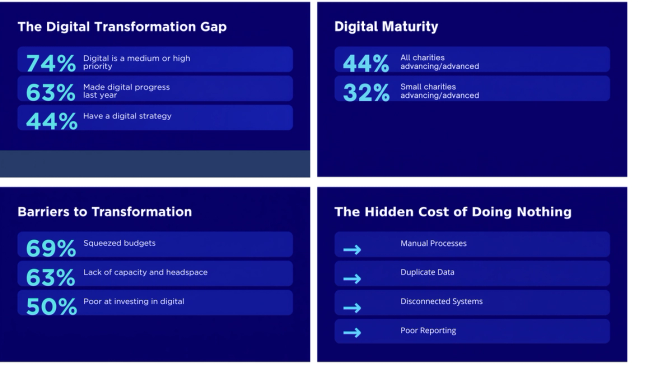
⚠️ 74% say digital is important, yet only 44% have a strategy. This is the UK's digital planning gap.
⚠️Two-thirds of small charities still do not consider themselves digitally advanced.
⚠️Money Remains the Biggest Barrier
The challenge isn't recognising the need for digital transformation. The challenge is finding the time, money and confidence to make it happen.
But doing nothing can also have a cost. Manual processes, duplicated data, disconnected systems and poor reporting all consume time and money that could otherwise be directed towards mission delivery.
Expectations Are Changing
Digital transformation is not simply about internal efficiency. Funders, supporters and the public increasingly expect organisations to:
- communicate clearly;
- demonstrate impact;
- provide accessible information; and
- show good governance and accountability.
Research commissioned by the Charity Commission found that people increasingly want charities to make information about their activities, finances and impact easier to access and understand. At the same time, digital technology has become part of the infrastructure that enables charities to work at scale, respond quickly and engage effectively with supporters and beneficiaries.
Digital Exclusion Cannot Be Ignored
Digital transformation is also about inclusion.
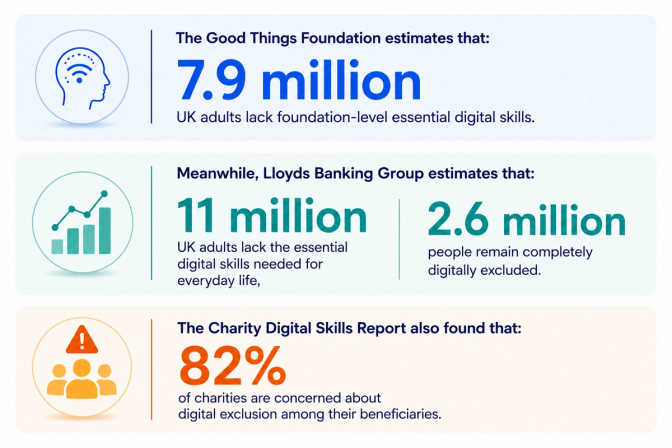
This means that digital transformation isn't simply about adopting new tools.
It is also about ensuring that services remain accessible and that nobody is left behind.
What Do We Actually Mean by Digital Transformation?
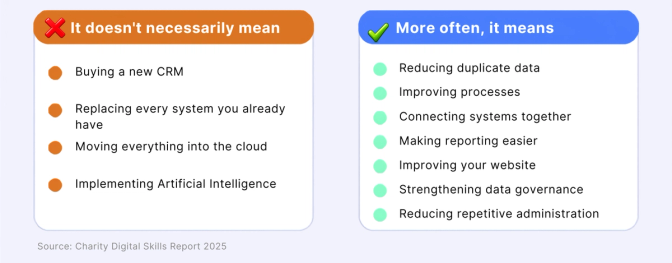
The key question is not:
What technology should we buy?
The better question is:
What is stopping us from working effectively, and how can digital help?
FIVE WARNING SIGNS THAT YOUR ORGANISATION NEEDS TO ACT
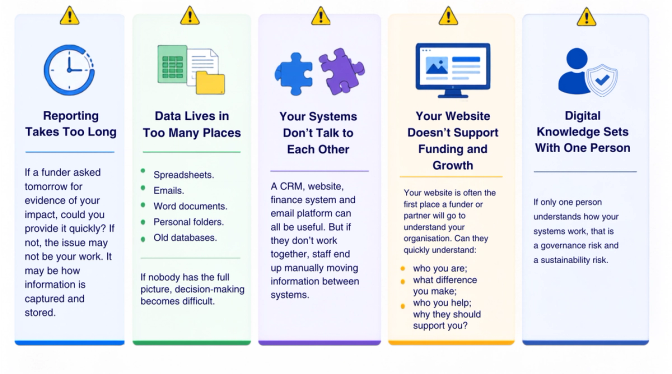
Good systems and data practices help you save time, make better decisions, and demonstrate your impact with confidence.
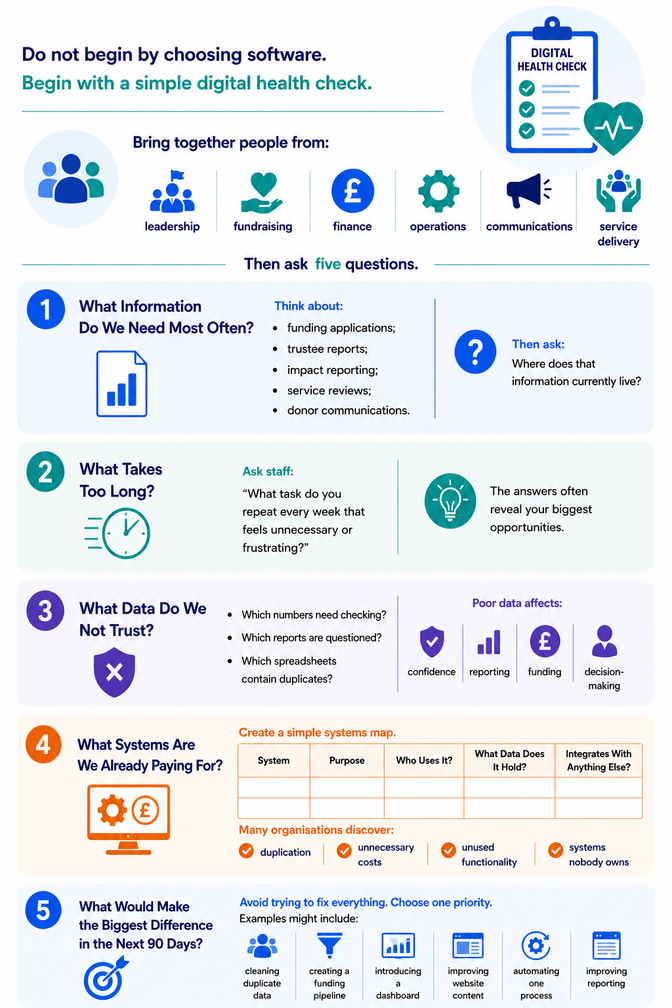
WHERE TO START
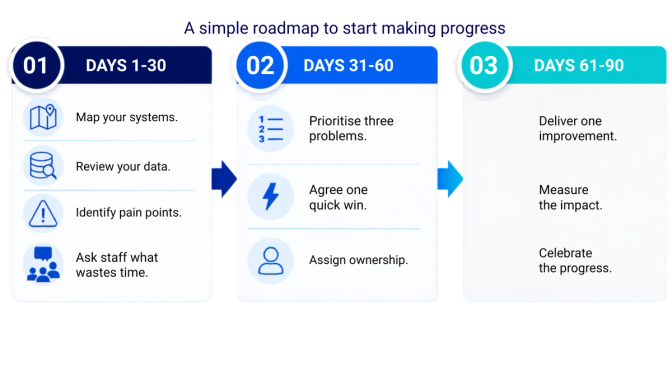
A SIMPLE 90-DAY ACTION PLAN
QUESTIONS FOR LEADERS AND TRUSTEES
- Do we have a digital strategy?
- Can we trust our data?
- Are we investing enough in digital skills?
- Could our systems cope with growth?
- Does our website support funding and credibility?
- Are we confident about GDPR and governance?
These are not IT questions. They are sustainability questions.
THREE THINGS YOU CAN DO THIS WEEK
1. Create a Systems Map.
2. Ask your team:
"What wastes the most time?"
3. Identify one process that could be made simpler.
That's it. That is enough to begin. Digital transformation starts by understanding where you are today and taking one practical step forward.
FINAL THOUGHT
Organisations that thrive over the coming years are unlikely to be those with the biggest technology budgets. They are more likely to be the organisations that use digital intentionally to become:
- more efficient;
- more resilient;
- easier to fund;
- easier to manage; and
- better able to deliver impact.
Digital transformation isn't really about technology. It's about building organisations that are stronger, more sustainable and better equipped to create change.
And it starts with one simple question:
What is the first thing we can make simpler?
REFERENCES
- Charity Digital Skills Report 2025.
- National Council for Voluntary Organisations (NCVO), The Road Ahead 2025.
- Good Things Foundation, UK Digital Inclusion Statistics.
- Lloyds Banking Group, Consumer Digital Index.
- Charity Commission for England and Wales, Charity Transparency Research.
NEXT EPISODE
How to Fund Digital Transformation in the Nonprofit Sector
We'll explore practical ways to fund CRM projects, websites, digital infrastructure, consultancy and change management.