
I've been working with Salesforce in the charity and nonprofit sector for more years than I like to admit. And one of the things I still find quite remarkable is just how much technology charities and nonprofits can get completely free.
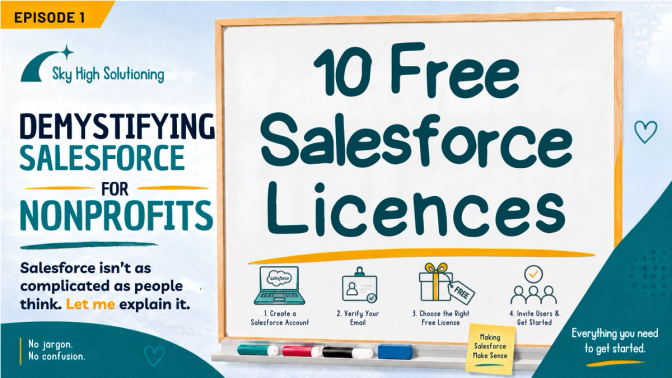
We're talking about 10 enterprise-level Salesforce licences, not a 30-day trial or a basic introductory CRM.
But, and it's a reasonable BUT, what does free actually mean?
Quite a lot, actually!
Imagine a small charity with six members of staff, a team of volunteers, several funded programmes and a growing community of supporters.
With the right Salesforce setup, that charity could manage much of its everyday work through one connected system.
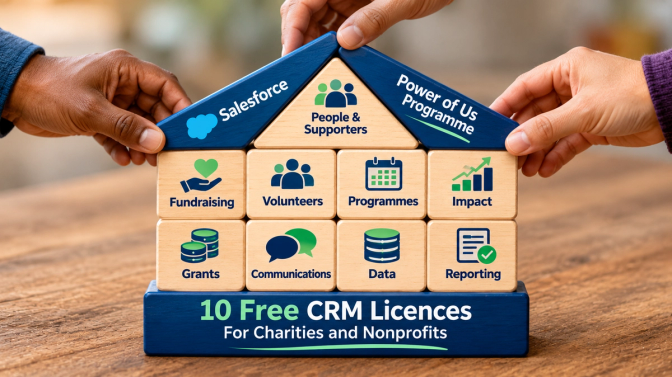
Fundraising, donations and supporter relationships can all be managed in Salesforce. So can programmes, service delivery, volunteer activities, reporting and measuring outcomes.
There's also the option to automate routine tasks, create dashboards, organise communications and connect information across different parts of the organisation.
Salesforce provides nonprofit-specific functionality through its newer nonprofit platform and through established free applications such as Nonprofit Success Pack (NPSP), Program Management Module (PMM) and Volunteers for Salesforce (V4S).
The applications and features available depend on which Salesforce licence bundle an organisation chooses, and some need to be installed or configured.
But I think it's quite extraordinary how much of a charity's day-to-day CRM and operational work can be brought together without another software subscription.
So, what isn't free?
Well, there's the important distinction between free licences and the cost of getting everything working.
There may be data to migrate, processes to configure, colleagues to train and other systems to connect. All of that takes time, whether you do it internally or bring in additional expertise.
Some things, such as extra user licences, specialist marketing applications, payment processing and certain advanced features, may also cost money.
And charities often need other software, such as an accounting package, alongside their CRM.
But there are choices. Salesforce includes integration capabilities, and sometimes a free connector, a simple data import or some carefully configured automation is all that's needed. More complex connections may involve development or third-party subscription costs.
I've found that the technology itself is often the straightforward part. What's important is having the time to work alongside people, understand their priorities and develop something that genuinely supports what they do.
And the licences don't expire?
That's right. Under the Power of Us Programme, Salesforce's 10 donated licences have no expiry date, subject to the programme's terms.
So a charity doesn't have to start paying for those donated licences simply because its first year has ended.
For me, that's the exciting part. It's not just about getting something free today. It's about having the opportunity to build something useful that can develop over time.
And that's worth exploring.
Check out our YouTube Channel to find out more about free Salesforce CRM licences for charities and nonprofits.
10 Free Salesforce Licences for Charities and Nonprofits | Demystifying Salesforce