

I've worked with quite a few CRM systems over the years. And although there are some excellent alternatives
, I keep coming back to Salesforce. Not because every charity needs it, but because of its flexibility, the support available and something that has always resonated with me: the company's commitment to the charity and nonprofit sector.
Since Salesforce was founded in 1999, philanthropy has been part of its corporate culture. Its 1-1-1 model commits 1% of equity, 1% of product and 1% of employees' time to giving back. That philosophy, and the community it has helped create, closely reflect my own values. And it is why I am confident about working with Salesforce for nonprofits: free licences and the extended functionality that goes with them will continue into the future.
Building around people, not technology
One of the things I enjoy most about working with charities and nonprofits is listening to how people work. They know their organisations, understand their challenges and usually have a good idea of what they'd like to improve.
My job is to listen, ask questions and find ways to make the technology work for them. With Salesforce, we can create fields, change layouts, build automations and develop reports around the way an organisation works. We can start with something relatively simple and introduce more functionality as people become comfortable with the changes.
Keeping things simple and affordable
There are some excellent off-the-shelf charity CRMs, including Beacon and Donorfy, particularly for fundraising and donor management. But Salesforce can offer a straightforward starting point too, with standard features for managing contacts, organisations, activities and reports. If that's all a charity needs, there's no reason to make things more complicated.
Cost matters too. Through its Power of Us Programme, Salesforce offers eligible charities 10 donated CRM licences. There may still be costs for setup, training and ongoing administration, but not every organisation needs a major implementation project.
Connecting the bigger picture
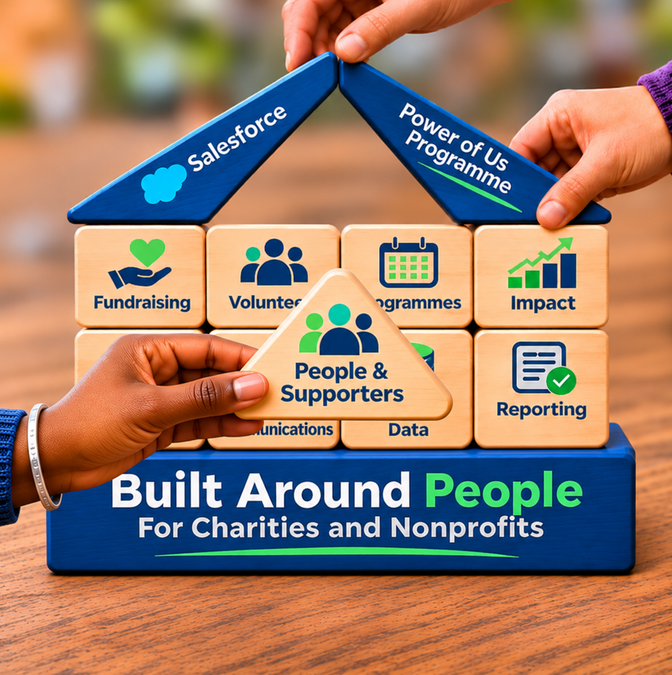
Another reason I favour Salesforce is its ability to connect different activities across an organisation. A fundraising team might be recording grants, supporters and donations, while programme colleagues are tracking services, participation and outcomes. When that information is connected, it becomes much easier to understand what's happening across the organisation and report on its work.
Then there are volunteers, partners, communications and all the everyday tasks that keep things moving. Salesforce can bring these activities together, while giving organisations control over who can access particular information. And as needs develop, we can often build on what's already there rather than introducing another system.
Learning, sharing and independence
I also value Salesforce's extraordinary learning community. The training resources, documentation and willingness of people to share their expertise make it easier for charities to develop the skills to manage their own CRM.
We have created our Demystifying Salesforce for Charities and Nonprofits YouTube series to complement what is freely available, offering short, practical walkthroughs to help organisations explore Salesforce for themselves
Not every charity needs a consultant. Sometimes my role is to design a solution; sometimes it's simply helping people make better use of what they already have. Ultimately, I want organisations to become confident and self-sufficient.
Why Salesforce remains my choice
For me, choosing a charity CRM isn't about having the most sophisticated technology. It's about understanding what an organisation needs and finding the most practical way to support it.
Salesforce gives me the freedom to start simply or develop something more tailored, backed by a company whose commitment to the nonprofit community I genuinely value.
It's not about how much Salesforce can do. It's about making sure it does what the organisation needs.
And that's why, after all these years, it remains my CRM of choice.